Enterprise code review in minutes, not weeks
Drag in a repository and CodeGuard runs an audit-grade security, logic and dependency review against 500+ enterprise benchmarks — then hands you a scored PDF & Word report. No setup, no agents.
Drag & drop a .zip · Runs in your session · Your code is analyzed, not stored
Findings mapped to the standards auditors trust
Audit-grade rigor, without the audit-grade wait
What takes a senior engineer days of manual review, CodeGuard delivers in minutes — consistently, and mapped to the standards your auditors expect.
Built for enterprise-scale review
The rigor of a staff security engineer, applied consistently across every team, repo, and legacy dependency.
SAST & logic review
Static analysis for injection, secrets, crypto and access-control flaws — paired with AI logic review that reasons about correctness, not just patterns.
OWASP / CWE mapped
Every finding is severity-rated and mapped to a CWE so it slots straight into your risk register and audit evidence.
Dependency & supply chain
Flags outdated and vulnerable packages from your manifests so legacy transitive risk doesn't slip through the gate.
Gated, repeatable process
A consistent, systematic review every time — the same rigor across hundreds of teams and repositories.
Health scoring
A single 0–100 score and letter grade summarize posture for stakeholders, with drill-down for engineers.
PDF & Word reports
One click produces an executive-ready PDF and an editable Word document — formatted, branded, and shareable.
Three steps to a report
From archive to audit-ready document in minutes.
Drag & drop
Drop a project .zip into CodeGuard. No agents, no repo access, no config.
Watch it review
See files stream through the pipeline and findings surface live as the engine works.
Export & remediate
Get a scored report with prioritized, concrete fixes — download as PDF or Word.
See exactly what you get
Every review produces a branded, audit-ready report — a graded scorecard, per-dimension assessments, file:line findings, a plain-language summary and a copy-paste fix prompt.
- 12-dimension graded scorecard
- Per-dimension assessments with evidence
- Findings cited to file:line, mapped to CWE
- Plain-language summary + remediation prompt
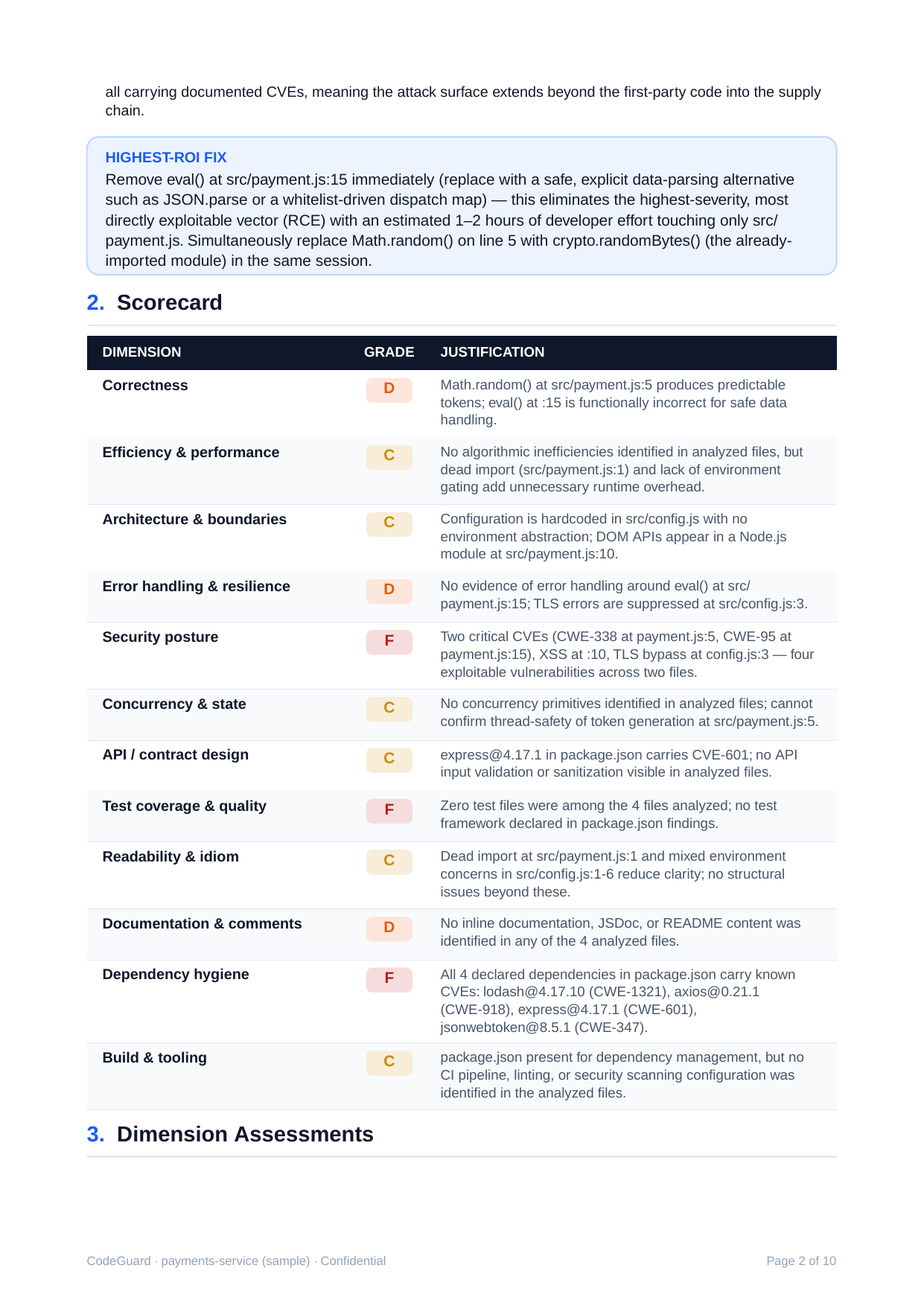
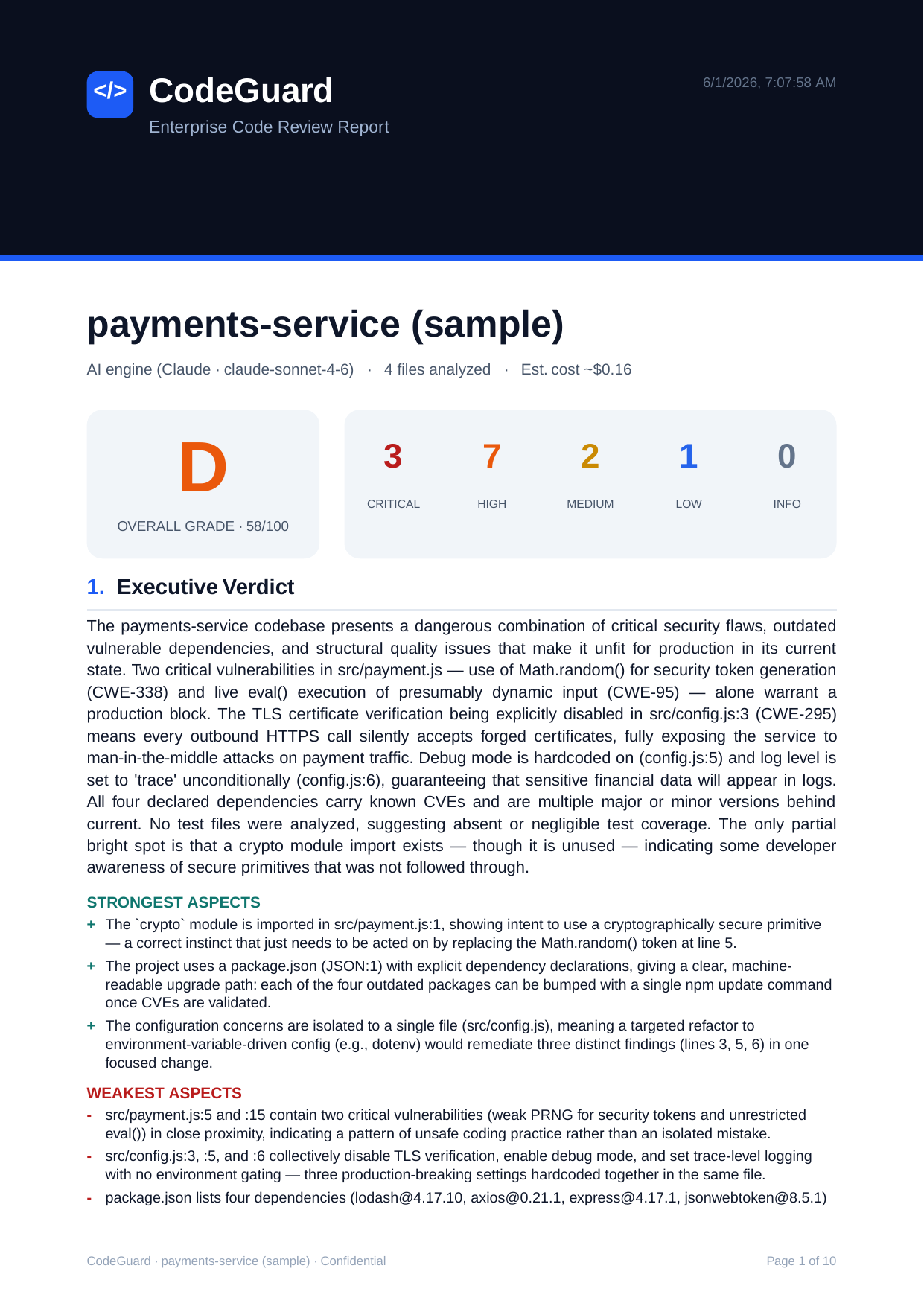
Sample report · payments-service
Mapped to the standards your auditors already trust
CodeGuard runs 500+ security, logic and configuration checks, each mapped to a recognized framework and a CWE — so findings drop straight into your risk register and audit evidence.
OWASP Top 10 (2025)
The current 2025 edition of the ten most critical web application security risks, now including software supply-chain failures.
CWE Top 25 (2025)
CISA & MITRE's 2025 list of the most dangerous software weaknesses, led by XSS, SQL injection and CSRF.
MITRE CWE
Every finding is mapped to a Common Weakness Enumeration identifier for traceability.
OWASP ASVS
Application Security Verification Standard controls for design and implementation.
NIST SSDF (SP 800-218)
The Secure Software Development Framework required across U.S. federal supply chains.
PCI DSS 4.0.1
Secure-coding and code-review requirements for payment environments, fully mandatory since March 2025.
ISO/IEC 27001 & 27034
Information-security management and application-security control mappings.
CIS Benchmarks
Consensus secure-configuration guidance that maps onward to NIST, PCI and ISO.
SQL/NoSQL injection, OS command injection, XSS, SSRF, path traversal, XXE
API keys, cloud access keys, private keys, tokens, hardcoded passwords
Weak hashes (MD5/SHA-1), insecure randomness, broken ciphers, disabled TLS verification
Broken authn, missing authz, IDOR, session fixation, JWT misuse
Known-vulnerable packages, outdated transitive deps, typosquatting risk
Race conditions, null/error handling, off-by-one, business-logic flaws
Debug mode, verbose errors, insecure defaults, PII logging
The most rigorous review, powered by the best model
CodeGuard runs on Claude — the model a security-first AI lab built and proved on real-world code. It reasons about how data flows and how components interact, catching logic and novel vulnerabilities that rule-based scanners miss.
Real vulnerabilities Claude found in production open-source code — some undetected for decades.
Claude leads the SWE-bench Verified coding benchmark (May 2026).
Fewer security issues on pull requests reviewed with Claude.
Code-review capability by approach
Higher is better · indexed 0–100
AI bars reflect SWE-bench Verified results (May 2026): Claude Opus 4.8 ~88.6%, GPT-5.3 Codex ~85%, Gemini 3.1 Pro ~75%. The traditional-review bar is an indicative baseline for manual + rule-based SAST, which resolves far fewer real issues and carries higher false-positive rates. Benchmarks evolve — figures are point-in-time.
Your source stays yours
A code-review tool sees everything — so CodeGuard is built so the act of reviewing never becomes the exposure. No persistence, no training on your code, and a fully local mode for regulated work.
In-session, in-memory processing
Archives are unpacked and analyzed in memory for the duration of a review and are never written to disk or retained after the report is generated.
Encrypted in transit
Every upload and API call travels over TLS 1.2+. Source is never transmitted in clear text.
Local-only static engine
The deterministic engine runs with zero outbound calls — your code never leaves the host. Ideal for air-gapped and regulated environments.
Private AI analysis
When AI review is enabled, only first-party source is sent to your configured model provider over TLS. Inputs are not used to train models, and zero-retention processing is supported.
Minimized exposure
Dependencies, binaries and build artifacts are skipped automatically — review focuses on your code, not third-party blobs.
Self-host & bring-your-own-key
Run behind your firewall with your own API key, or deploy the whole platform on-premise for full data sovereignty.
Pricing that scales from you to your whole org
Start free as an individual, grow with your team, and graduate to enterprise governance — without changing tools.
Personal
For individual developers and evaluation.
3 free AI reviews, then unlimited static.
- Unlimited static-engine reviews
- 3 free AI-powered reviews
- PDF & Word report export
- OWASP / CWE-mapped findings
- Single user
Team
For small teams shipping together.
Activate instantly by card · cancel anytime.
- Everything in Personal
- Unlimited AI-powered reviews
- Review history & trend trackingRoadmap
- Up to 25 users + shared report libraryRoadmap
- Custom severity & gate thresholdsRoadmap
- Priority support
Enterprise
For group IT and regulated organizations.
No trial — guided onboarding.
- Everything in Team
- SSO / SAML & role-based access controlRoadmap
- Self-hosted / air-gapped deployment
- VCS & CI/CD gating (GitHub, GitLab, Azure DevOps)Roadmap
- Custom rules & policy-as-codeRoadmap
- Audit logs & compliance mapping (SOC 2, ISO 27001)Roadmap
- SLA & dedicated success engineer
Prices shown in USD. Annual billing available. Enterprise includes self-hosting and custom compliance mapping.
Questions, answered
The things security leads and engineers ask before their first review.
Is it safe to upload our source code?
Archives are unpacked and analyzed in memory for the duration of the review and are never written to disk or retained afterward. Everything travels over TLS, your code is never used to train models, and the deterministic static engine can run with zero outbound calls for air-gapped work.
How is this different from a SAST scanner we already run?
Rule-based scanners match patterns; CodeGuard pairs 500+ deterministic checks with an AI reviewer that reasons about how your data flows and how components interact — catching logic flaws, broken access control and novel vulnerabilities that pattern matching misses, with far fewer false positives.
What do we actually get at the end?
A 0–100 health score with a letter grade, a 12-dimension scorecard, every finding cited to file:line and mapped to a CWE, a plain-language executive summary, and one-click PDF, Word and SARIF exports — ready for your risk register, auditors, or CI pipeline.
Which languages and frameworks are covered?
The engine reviews all common languages — JavaScript/TypeScript, Python, Java, Go, C#, PHP, Ruby, Rust and more — plus dependency manifests (npm, pip, Maven and friends) for known-vulnerable packages.
How does payment work? Can we cancel?
Personal is free forever with 3 AI-powered reviews included. Team is $29 per seat per month, activated instantly by card through Stripe's secure checkout — cancel anytime and you keep access until the end of the billing period. Enterprise is an annual contract through our sales team.
Do we need to install anything or connect our repos?
No. Drag in a .zip and the review starts — no agents, no repo permissions, no CI changes, no config. Your first report is minutes away.
Ship code your auditors trust
Your first audit-grade review is five minutes away — no credit card, no setup, no repo access. Drag in a .zip and see what's hiding in your code.
Free forever for individuals · Team activates instantly by card